

Chu Văn An

Nội dung bài viết
Polymers in wastewater treatment: Its applications in wastewater treatment. Polymers in wastewater treatment are one of the effective solutions. And is widely used to improve sedimentation, flocculation and water separation processes. With the ability to increase processing efficiency, reduce operating time and costs. Polymers have become the top choice in many wastewater treatment systems. An expert in the field of chemical supply at Vu Hoang. I will learn with you about the roles and common types of polymers such as anionic polymers and cationic polymers. And instructions for proper use to achieve optimal results.
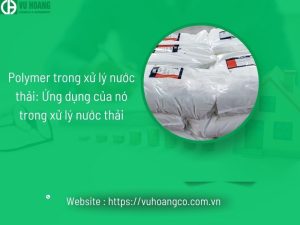 Polymer in wastewater treatment: Its application in wastewater treatment
Polymers and their role in wastewater treatment:
The role of polymers in wastewater treatment
Polymers are one of the important chemicals used in wastewater treatment. Thanks to its ability to improve the efficiency of flocculation, flocculation and sedimentation of suspended solids.
Polymers are macromolecular compounds made up of many monomer units linked together through chemical bonds. In wastewater treatment, polymers are used as flocculation and flocculation aids. Helps remove suspended particles, organic matter and other impurities from wastewater.
Polymers in wastewater treatment are divided into many types based on origin and chemical properties:
- Inorganic polymers: Are inorganic compounds such as polyaluminum chloride (PAC), aluminum sulfate (Al2(SO4)3). Often used to flocculate suspended particles in wastewater.
- Organic polymers: Are macromolecular organic compounds, often synthesized from monomers such as acrylamide. Widely used thanks to its high efficiency and ability to treat many different types of wastewater.
- Natural polymers: Derived from nature, such as starch, chitosan. Environmentally friendly but processing efficiency is often lower than synthetic polymers.
- Synthetic polymers: Synthesized from chemical monomers, such as polyacrylamide (PAM). This is the most popular polymer in wastewater treatment thanks to its high efficiency. Easily adjust chemical properties to suit each type of wastewater.
Mechanism of action of polymers in wastewater treatment:
- Coagulation: Polymer helps neutralize the electrical charge of suspended particles in wastewater. Reduces electrostatic repulsion between particles, thereby facilitating their adhesion to each other.
- Flocculation: After the particles are electrically neutralized. The polymer continues to bind small particles into larger flocs, which easily settle to the bottom of the tank.
- Sedimentation: The large flocs that are formed will quickly settle to the bottom of the tank thanks to gravity. Helps separate suspended solids from wastewater.
The role of polymers in wastewater treatment:
- Increase treatment efficiency: Polymer helps increase sedimentation speed. And improve the ability to remove suspended particles, organic matter and grease in wastewater.
- Cost savings: Thanks to effective flocculation and flocculation ability. Polymers help reduce the amount of chemicals used and processing time.
- Diverse applications: Polymers are used in many different types of wastewater. From domestic and industrial wastewater to medical wastewater.
Polymers in wastewater treatment
Anionic polymers
Characteristics: Anionic polymers have a negative charge, often synthesized from monomers such as acrylamide and acrylic acid. They have the ability to neutralize positively charged suspended particles in wastewater. This helps effectively coagulate and create flocs. Anionic polymers have good solubility in water and work effectively in pH environments from 6 to 9.
Application:
- Industrial wastewater treatment: Anionic polymers are widely used in industries. Such as textile dyeing, paper, food and chemicals to remove suspended particles and solids.
- Sludge treatment: Helps enhance water separation ability in wastewater sludge. Reduce sludge volume and save treatment costs.
- Water filtration: Anionic polymers are also used in water filtration systems. To improve output water quality.
See more: >>> Anion Polymer A1110 chemical in wastewater treatment
Cationic polymers
Characteristics: Cationic polymers have a positive charge. Usually synthesized from monomers such as acrylamide and dimethyl diallyl ammonium chloride (DMDAAC). They have the ability to neutralize negatively charged suspended particles. Such as colloidal particles, organic matter and microorganisms in wastewater. Cationic polymers work effectively in pH environments from 4 to 8 and have strong flocculation ability.
Application:
- Domestic wastewater treatment: Cationic polymer is used to remove organic substances, grease and microorganisms in domestic wastewater.
- Medical wastewater treatment: Particularly effective in removing colloidal particles and microorganisms in hospital and laboratory wastewater.
- Activated sludge treatment: Cationic polymer helps improve sludge settlement in biological wastewater treatment systems.
Non-ionic polymers
Characteristics: Non-ionic polymer without charge, usually synthesized from acrylamide. They have the ability to bind to suspended particles in wastewater. Through physical forces of attraction, rather than neutralizing the charge. Non-ionic polymers work well in neutral pH environments and are highly soluble in water.
Application:
- Industrial wastewater treatment: Non-ionic polymers are used in industries. Such as mineral mining, petroleum and chemical manufacturing to remove suspended particles and solids.
- Highly saline wastewater treatment: Effective in wastewater treatment systems containing salt. Or heavy metals, where charged polymers don’t work well.
- Supports filtration and water separation: Non-ionic polymers help improve filtration and water separation in wastewater treatment systems.
Applications of anionic polymers
Anionic polymer is a powdery coagulant that plays an important role in sedimentation. And improve wastewater treatment efficiency. Here are the main applications:
- Mechanical dewatering and inorganic sludge treatment: Anionic polymer helps increase product rates. And improve water quality during sludge treatment.
- Improve sedimentation rate and water quality: Anionic polymer enhances flocculation ability. Helps suspended particles quickly adhere and settle to the bottom of the tank.
- Supports coagulation with other coagulants: When combined with inorganic coagulants (such as PAC chemicals). Or organic, anionic polymer increases treatment efficiency, reduces time and operating costs.
- Water separation and improved water input: Anionic polymers support water separation in wastewater sludge. Helps reduce sludge volume and improve input, process and output water quality.
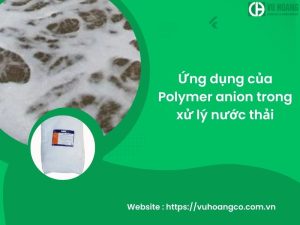 Application of anionic polymers in wastewater treatment
- Flotation: Anionic polymer helps to recover solids better during the flotation process, thereby improving water quality.
- Filtration: Anionic polymer improves filtered water quality. Helps the filtration system operate more effectively.
Refer to other articles: >>> What is anionic polymer? Application of anionic polymers and cationic polymers in wastewater treatment
How to use anionic polymer
To achieve optimal effectiveness, anionic Polymer needs to be used properly according to the following steps:
- Principle of use: Anionic polymer is dissolved in water to form a stock solution. This solution is then pumped into the wastewater treatment system through an automatic metering pump.
- Stock solution concentration: Concentration is usually mixed at 0.01 – 0.2% by weight. Depending on the characteristics of wastewater and treatment requirements.
- How to prepare: Mix anionic Polymer with water in appropriate proportions. For example: To prepare a 0.01% solution, use 0.1kg of anionic polymer dissolved in 1,000 liters of water. Stir the solution well for 60 minutes to completely dissolve the Polymer, ensuring effective treatment.
- Adjust Polymer concentration: Depending on wastewater characteristics, adjust pump flow. Or stock solution concentration to optimize usage efficiency. This helps minimize the amount of Polymer used. At the same time, it reduces the amount of residue generated during the processing process.
Note when using anionic polymer
- Input water quality: Ensure wastewater has been pre-treated to reduce turbidity. and large impurities before using anionic polymer.
- Effective testing: Perform small tests (jar tests). To determine the optimal dosage of Polymer before applying it to the actual system.
- Labor safety: When mixing Polymer, it is necessary to use labor protection. To avoid direct contact with chemicals.
Applications of cationic polymers:
Cationic polymer is a powdery coagulant. Commonly used in wastewater treatment processes, especially liquid – solid classification. With the ability to improve water efficiency and quality. Cationic polymers are applied in the following cases:
- Conveyor sludge dewatering machine and centrifuge: Cationic polymer helps increase product rates and effectively recover chemicals. And reduce the volume of mud cake, thereby saving sludge treatment costs.
- Water sedimentation: Improve sedimentation efficiency, reduce the amount of suspended matter and turbidity in water. Significantly improves output water quality.
- Flotation: Supports the flotation process by recovering solids more effectively. Helps optimize the performance of the processing system.
- Filtration: Increases filtered water quality, reduces sediment and impurities. Make sure the output water meets standards.
- Thickener: Cationic polymer enhances setting and sedimentation. Helps treat sludge more effectively in sludge thickening systems.
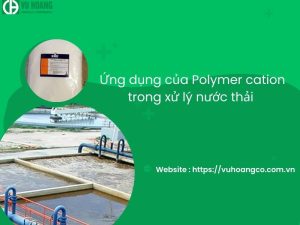 Application of cationic polymers in wastewater treatment
How to use Cationic Polymer
For optimal effectiveness, cationic polymers need to be used properly according to the following steps:
- Principle of use: Cationic polymer is dissolved in water to form a stock solution. This solution is then pumped into the wastewater treatment system. To perform flocculation and sedimentation processes.
- Stock solution concentration: Stock solution concentration is usually mixed at 0.01 – 0.2% by weight. Depending on the nature of wastewater and treatment requirements.
- How to prepare:
- Step 1: Add water to the tank.
- Step 2: Add cationic polymer in the corresponding amount to achieve the stock solution concentration. For example: To prepare a stock solution with a concentration of 0.01%, weigh 0.1 kg of Cationic Polymer and add it to 1,000 liters of water.
- Step 3: Turn on the stirrer for 60 minutes so that the Polymer completely dissolves in water.
- Dosing pump: Use an automatic dosing pump to bring Polymer solution into the system. Extraction concentration ranges from 0.1 – 20 ppm, depending on wastewater properties.
- Adjust the Polymer concentration in the system: Adjust the pump flow or stock solution concentration to create the largest floc with the lowest Polymer dosage. This helps reduce the amount of residue passing through the water collector, optimizing treatment efficiency and saving costs.
See more: >>> How are Polymer chemicals used in wastewater treatment?
Note when using cationic polymer
- Test before use: Perform a small test (jar test) to determine the optimal Polymer dosage before applying to the actual system.
- Work safety: Use protective equipment when preparing and operating. To avoid direct contact with chemicals.
- Periodic inspection: Monitor treatment efficiency and adjust Polymer dosage. If necessary to ensure output water quality.
Conclude
Polymers in wastewater treatment are an important and effective solution. Helps optimize the process of flocculation, flocculation and sedimentation of suspended solids. Depending on wastewater properties and treatment requirements. Choosing and using the right type of polymer such as anionic polymer, cationic polymer or non-ionic polymer. Will bring outstanding efficiency, save costs and ensure output water quality meets standards.
At Vu Hoang, we not only provide high quality polymers. It also provides comprehensive solutions, from consulting, testing to detailed usage instructions. With a team of experienced experts. We are committed to accompanying customers in treating wastewater effectively and sustainably.
Please contact Vu Hoang Chemical immediately for advice and supply of the best wastewater treatment chemical products. Helps you optimize processes and protect the environment!
Please contact us via HOTLINE or Website: https://vuhoangco.com.vn when you need it.
Nội dung được phát triển bởi đội ngũ truongchuvananhue.edu.vn với mục đích chia sẻ và tăng trải nghiệm khách hàng. Mọi ý kiến đóng góp xin vui lòng liên hệ tổng đài chăm sóc: 1900 0000 hoặc email: hotro@truongchuvananhue.edu.vn