

Chu Văn An

Nội dung bài viết
During operation, even if operated properly, capacitors can still have errors. To ensure operating performance and prevent risks that can cause fire and explosion, it is necessary to periodically check and maintain the capacitor. Below are 5 ways to check technical standard capacitors that Trường Chu Văn An has compiled.
Check the capacitor with a capacitance meter
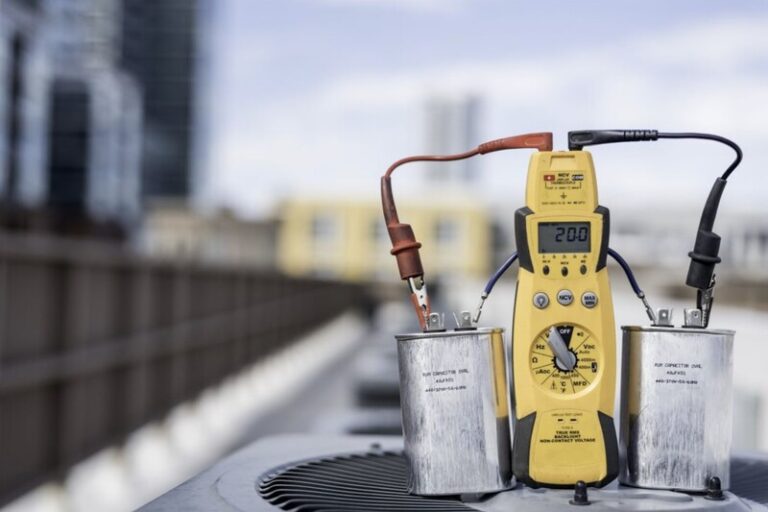
The typical parameter of a capacitor bank is capacitance, so using a capacitance meter is the most accurate way to measure whether a capacitor is alive or dead. The condition for using a capacitance meter is that the capacitor is unloaded and completely discharged. Through the capacitance level, we can know exactly whether the condition of the capacitor is good or not and when it needs to be replaced to ensure safety.
The detailed steps to check capacitors with a capacitance meter are as follows:
- Step 1: Prepare before measuring by disconnecting the power and safely discharging the capacitor.
- Step 2: Determine capacitor parameters. Read the capacitance value (μF or kVAR) and rated voltage written on the capacitor body. For example: “50μF ±5%, 440V AC” or “25kVAR, 415V”.
- Step 3: Install the capacitance meter. Turn on the meter, select capacitance measurement mode – symbol “C” or “–|(–“, then select the appropriate scale (usually choose the automatic scale or the scale higher than the capacitor value of 20%).
- Step 4: Connect measuring leads. For 3-pole capacitors: Red wire → terminal A1 (or “+”). Black wire → terminal A2 (or “-“). Terminal A0 (if present) does not need to be connected during measurement
- Step 5: Take measurements and read results. Keep the probes in good contact for 5-10 seconds to stabilize the meter. The displayed value is the actual capacitance of the capacitor.
Compare results:
- If the measured value differs by ≤ ±10% compared to the recording on the capacitor: the capacitor still works well and can continue to be used.
- If the measured value is lower than >30%: the capacitor is dry, consider replacing the capacitor.
- If “0” or “OL” is displayed: the capacitor is short or open circuit, need to be replaced immediately.
- If the value fluctuates unstable: the capacitor is leaking, needs to be checked and replaced.
Check the capacitor with a multimeter
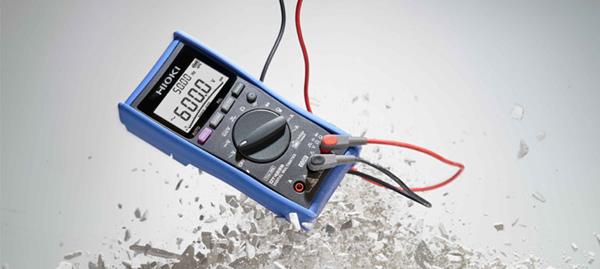
The way to check a capacitor with a multimeter is similar to when using a capacitance meter. Note that with AC or DC capacitors, set the corresponding voltage measurement mode. Then turn the knob on the multimeter to capacitance measurement mode. Finally, measure electricity.
Some multimeter lines have REL relative capacitance mode. When measuring low capacitance values, this mode eliminates capacitance on the test leads and increases the accuracy of the results. To activate this mode on the multimeter, leave the test lead open and press the REL button.
Steps to check capacitors with a multimeter:
- Step 1: Disconnect the capacitor to ensure it is not connected to the power source or any circuit.
- Step 2: Safely discharge the capacitor by using a resistor (about 5-10kΩ) or the head of a screwdriver to touch the two capacitor terminals to discharge all the electricity.
- Step 3: Read the capacitance value on the capacitor shell. Capacitance values (F, µF, nF, pF) are often recorded directly on the capacitor body or encoded. For example: 50µF ±10%, 100nF, or 2200pF.
- Step 4: Install the multimeter. Switch the meter scale to capacitance measurement mode. If the meter does not have a capacitance measurement function, you can use the Ω (resistance) scale to check for leaking capacitors.
- Step 5: Connect the measuring probe to the capacitor. Red rod: Positive (+) terminal of the capacitor (usually marked). Black rod: Negative terminal (–) (usually the longer leg on the new capacitor).
- Step 6: Read the results and evaluate. If the measured value is close to the parameters recorded on the capacitor (within the tolerance range, for example ±10%), the capacitor is still working well. If the measured value is much lower than the parameter or the meter displays “0” (capacitor shorted) or “OL” (capacitor open circuit), then there is a high possibility that the capacitor is damaged.
Note: With 3-phase capacitors, if you cannot measure each phase directly, you can short-circuit two phases and measure the remaining phase. The measured value will be half the nominal value of a phase. Normally, capacitor banks of different brands will have the following parameters:
- Capacitor 10 kVAr – 440V: single-phase capacity of 164 µF
- Capacitor 15 kVAr – 440V: single-phase capacity of 246.6 µF
- Capacitor 20 kVAr – 440V: single-phase capacity of 328.8 µF
- Capacitor 30 kVAr – 440V: single-phase capacity of 493.2 µF
Read more: Instructions for calculating and selecting capacitors based on capacity
Check the capacitor with a voltmeter
When you don’t have a specialized capacitance meter or want to quickly check the condition of the capacitor during routine maintenance, you can use a voltmeter to check the capacitor.
The steps to check capacitors with a voltmeter are as follows:
- Step 1: Disconnect and discharge the capacitor
- Step 2: Check rated voltage. Do not exceed this value when testing, otherwise the capacitor may explode.
- Step 3: Charge the capacitor. Use a direct current (DC) power source with a voltage 10% lower than the rated voltage (for example: 10V capacitor – use a 9V battery). Then connect the correct polarity and keep the connection for a few seconds to allow the capacitor to fully charge.
- Step 4: Install the voltmeter. Adjust the voltmeter to the DC voltage scale (V–). Choose a scale higher than the charging voltage (for example, if using a 9V battery, choose a 20V DC scale).
- Step 5: Measure capacitor voltage. The first time, record the initial voltage result (must be close to the charging voltage). The second time, if the voltage drops very slowly, the capacitor will still work well. If the voltage drops quickly to 0V, the capacitor is at risk of being damaged.
Note: Only use low voltage DC power to test capacitors, do not use AC power.
This method is suitable for testing electrolytic capacitors. With non-polar capacitors (ceramic, film), a capacitance meter should be used. In case the capacitor is bulging/leaking oil, there is no need to check but the capacitor should be replaced immediately.
Check the capacitor with a clamp meter
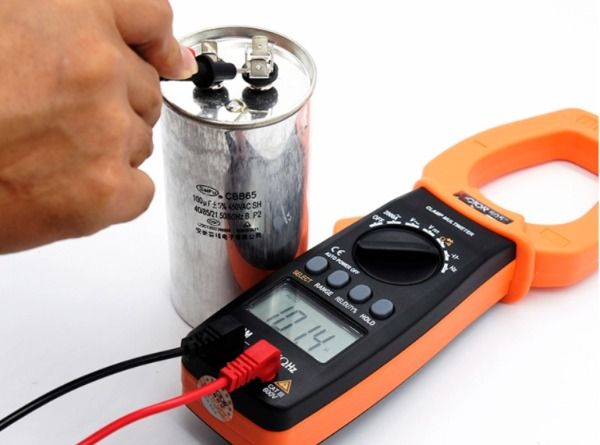
Clamp meters are used to test capacitor banks by measuring the current through the capacitor during operation. This is an indirect measurement with the condition that the capacitor is operating within the rated voltage and is stable. Through measurements after each period of time, the operating current of the capacitor can be compared with the rated current, thereby evaluating the quality of the capacitor.
Steps to measure capacitors with a clamp meter:
- Step 1: Install the capacitor into the circuit, making sure to connect the capacitor according to the diagram (usually in parallel with the load).
- Step 2: Install the clamp meter. Select the AC Current (A~) scale. Choose the appropriate measuring range (20% higher than the calculated line).
- Step 3: Measure the current. Clamp a clamp meter onto each phase wire supplying the capacitor (do not clamp multiple wires together) then record the stable current value.
Measurement results are evaluated as follows:
- Current ≈ calculated value: capacitor still works well.
- Current lower than 30%: capacitor has reduced capacity, chemical dryness, needs to be replaced
- Current = 0: capacitor is open circuit, need to check connection or replace
- The current is too high (>10% compared to the norm): the capacitor is partially shorted, lost insulation, needs to be replaced immediately.
Note:
- Do not measure directly on the neutral wire or common wire (high error).
- With 3-phase capacitors: Measure each phase in turn, compare the current balance (difference ≤ 5%).
- In case of suspicion of error, it is necessary to combine capacitance measurement with a multimeter to verify.
Read more: Overview of oil capacitors: Structure and operating principles
How to check capacitors with resistance
If you want to test a capacitor (AC, DC, polarized or non-polarized) by measuring resistance, follow these steps:
- Step 1: Disconnect and discharge the capacitor.
- Step 2: Install the multimeter. Turn on the meter, select resistance measurement mode (Ω). Choose a scale of 1KΩ or higher (if you use a scale that is too low, the results may be inaccurate).
- Step 3. Connect the measuring lead to the capacitor. Red rod: Positive pole (+) of the capacitor (with polarized capacitors). Black rod: Negative pole (–). With non-polar capacitors, the probe can be reversed without affecting the results.
- Step 4: Read the results and evaluate. If the meter initially shows low resistance, then gradually increases to OL (Overload), it shows that the capacitor is charged/discharged normally.
Broken capacitors can fall into the following cases:
- Always displays “0”: Capacitor is short circuited.
- Always displays “OL” immediately: Capacitor is open circuit (not charged).
- Resistance does not increase or fluctuate: Capacitor is leaking.
Note:
- This method only briefly checks live/dead capacitors, does not accurately measure capacitance.
- To measure capacitance value (µF, nF), you need to use a meter with capacitance (C) measurement function.
- With large capacitance capacitors (>1000µF), charge/discharge times will be longer.
Some common capacitor errors and how to fix them
Above, Trường Chu Văn An has helped you learn about testing capacitors. Please continue to follow our article to learn more about some errors when using capacitors as well as how to fix errors when this device fails.
- The relay is adjusted to the default value
After a period of using some capacitors, the phenomenon of the capacitor not working may occur. The cause may be that the capacitor control relay has been adjusted to the default value.
To fix this phenomenon, you need to check the relay again. If the relay is adjusted to the default values, you need to reset the operating parameters accordingly.
- That empty phenomenon has the value Cos phi
One of the reasons why the condenser does not work is due to incorrect connection of the current and voltage signals supplied to the relay.
To fix this problem, you need to follow these steps:
- Check the relay’s signal connection diagram according to the user manual.
- Make sure to connect the signal wires correctly according to the prescribed diagram.
- Check the relay’s switching operation.
If you connect the signal wires correctly according to the prescribed diagram but the relay still does not operate normally, the cause may be due to a broken relay. In this case, you need to replace the relay.
When the grid voltage is too high, the relay will signal to cut off the capacitor to protect the capacitor. However, continuously cutting off the capacitor will result in the relay’s setting values being reset to default and resulting in the relay not functioning correctly. In addition, continuously cutting off the capacitor can also cause the relay to be damaged.
Therefore, you need to reduce the transformer’s voltage step to reduce the grid voltage. This will help reduce the grid voltage to the appropriate level, ensuring that the capacitors and relays operate normally and correctly.
- The current into the relay is small
If the current entering the relay is small, it can also cause a phenomenon that is difficult to detect and control. The cause of this situation is because the current transformer has a turning ratio that is too large or when the current transformer angle error is too large.
To fix this problem, you need to follow these steps:
- Check the turning ratio of the current transformer. If the current transformer’s turning ratio is too large, it is necessary to replace the current transformer with a ratio appropriate to the load.
- Check the current transformer angle error of the capacitor. If the current transformer angle error of the capacitor is large, it is necessary to replace the capacitor with the appropriate current transformer angle error.
- Capacitor is exploded and condensed
There are many causes of condensation explosion and swelling, some of which include the following main causes:
- Poor contact connection: When connecting capacitors, if the contacts are not tightly connected or loose, it will cause an arc phenomenon leading to an electric current that does not ensure capacity. Depending on the duration of the arc phenomenon, the capacitor may swell or lose capacity.
- Improper technical design: If the system voltage is higher than the rated voltage of the capacitor, this device can explode or swell at any time.
- Poor capacitor quality: Poor quality capacitors can lose capacity after a period of use, and can even swell or explode.
Note when checking capacitors
- After the capacitor has just been cut off for testing, there is still residual charge on the terminal. You need to wait a while for the capacitor to fully discharge.
- If you need to urgently measure the capacitor, you can discharge the capacitor by attaching a limiting resistor to the capacitor terminals, then discharging electricity from the capacitor through the resistor and then to ground to avoid damage to the capacitor.
- It is necessary to ensure that the current through 3 phases (with 3-phase capacitors) is equal when checking the capacitor, equal to the rated current on the label.
Example of measuring current across a capacitor:
- Capacitor 5kVAr – 240V: I = 12A
- Capacitor 10kVAr – 250V: I = 23A
- Capacitor 15kVAr – 415V: I = 21A
- Capacitor 20kVAr – 440V: I = 26A
- Capacitor 25kVAr – 480V: I = 30A
- Capacitor 30kVAr – 525V: I = 33A
Thus, Trường Chu Văn An has just guided you through 5 ways to check capacitors according to technical standards, errors that commonly occur on capacitors and how to fix them. Hopefully through the above article, you have been equipped with the knowledge to operate capacitors effectively and safely. Visit: https://etinco.vn/tin-tuc/kien-thuc/ to learn more information about capacitors or other electrical equipment.
Nội dung được phát triển bởi đội ngũ truongchuvananhue.edu.vn với mục đích chia sẻ và tăng trải nghiệm khách hàng. Mọi ý kiến đóng góp xin vui lòng liên hệ tổng đài chăm sóc: 1900 0000 hoặc email: hotro@truongchuvananhue.edu.vn